
Inside Free Nelson Mandela with Director James Rogan
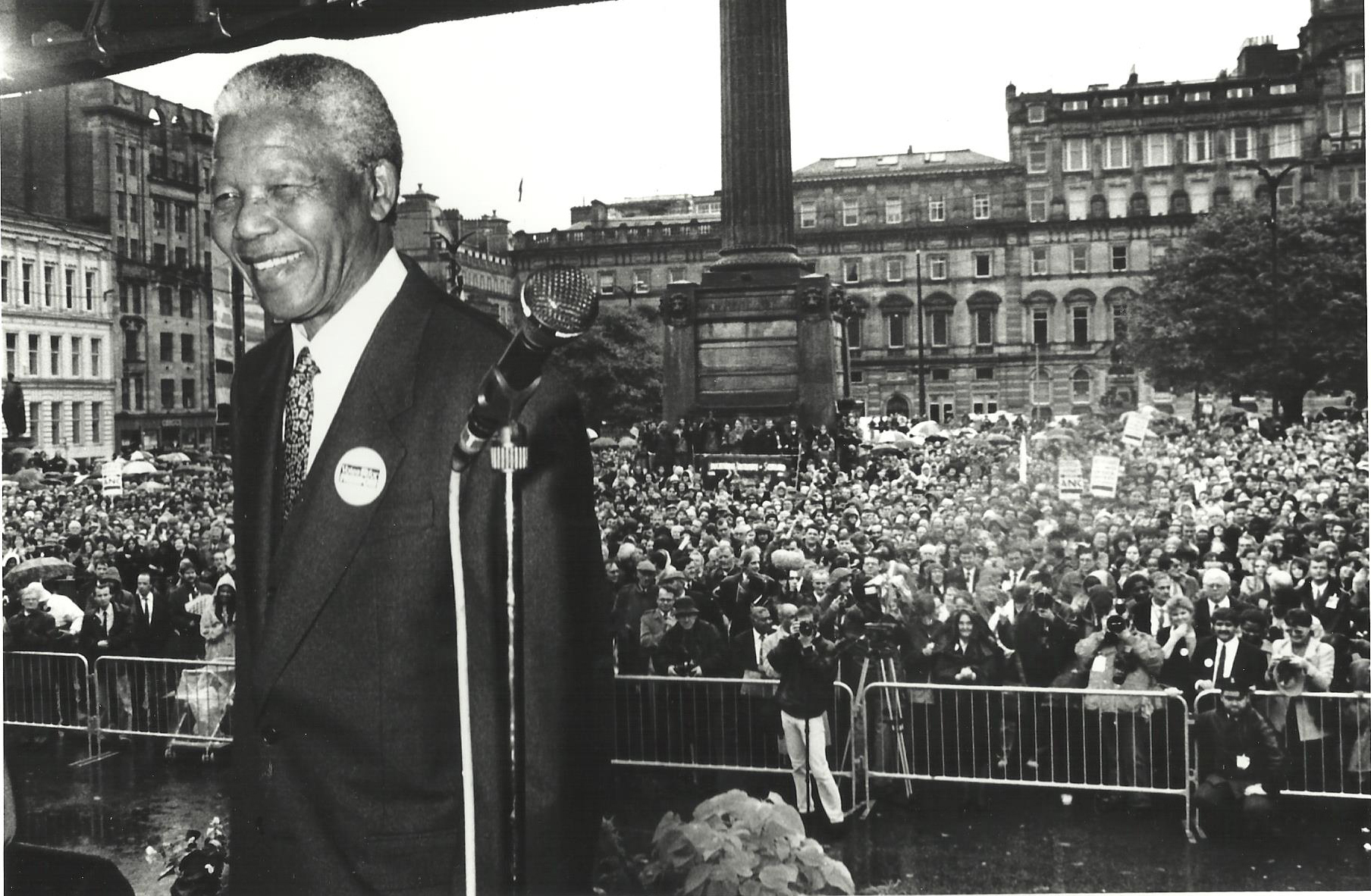
The odds of Nelson Mandela walking to freedom on that bright day, 11th February 1990, were always stacked against him. Yet hindsight gives the impression his freedom was inevitable. This was the starting point for our series.
Who was this man who befriended his prison guards and people wrote songs about? What is the story of Free Nelson Mandela?
Outside the prism of inevitability, it’s one of history’s most remarkable stories, full of twists, turns, new developments and cameos from popular figures.
During my lifetime, I have dedicated my life to this struggle of the African people. I have fought against white domination, and I have fought against black domination. I have cherished the ideal of a democratic and free society in which all persons will live together in harmony and with equal opportunities. It is an ideal for which I hope to live for and to see realised. But, My Lord, if it needs be, it is an ideal for which I am prepared to die. These words alone would have carved his place in history. But by holding on to the values they expressed throughout everything that happened to him, he became elevated to a moral leader who will be discussed for generations to come. It was important to show that Nelson Mandela was not alone on his journey. Nobody knew better than Mandela that when he was in prison, he became a symbol for an entire struggle and the many people who had given their lives to it. He did not operate in a vacuum. He stood on the shoulders of the people who came before him and relied on those who fought beside him. None more so than Oliver Tambo, who quietly went into exile to lead the African National Congress and build an anti-apartheid movement capable of freeing Mandela and the people of South Africa.
The series shows how the shadow of death stalked Mandela and how many people who took a stand ended up murdered. People like Steve Biko, who was beaten to death in a prison cell, a man who would have been a powerful and much needed leader for a new South Africa, or Ruth First, a journalist friend of Mandela’s, who was blown up by the apartheid regime for her courageous criticism of it. Oliver Tambo realised that against the backdrop of so many deaths, one way to keep Mandela alive was to ensure his name was on the lips of the anti-apartheid movement. Focusing on a single figure – one prisoner – would be more effective in capturing the imagination (and the indignation) of the world. People around the world were able to step out of their everyday lives and make a contribution to the fight against apartheid and freeing Mandela. They took part in direct action and mass protests, participated in boycotts and attended star-studded concerts. The movement to end apartheid and free Nelson Mandela is one of the most successful single-issue movements in history, despite leaders of the West, like Margaret Thatcher and Ronald Reagan, who branded Oliver Tambo’s African National Congress ‘a typical terrorist organisation’.
Against the growing clamour for his freedom, Mandela was isolated in prison, going through a unique personal torture. He was powerless as his wife Winnie, the love of his life, was harassed, tortured and banished by the racist regime. He witnessed her rise as a charismatic leader, the face of the struggle in South Africa and her ultimate fall into the kind of brutality that he had stood so firmly against. While his marriage broke apart, he built friendships with the guards that held him and even with members of the regime that persecuted him. He crossed a rubicon that few could imagine crossing, but it came at the cost of his family relationships Right from the beginning, music was at the heart of the struggle. My father is South African, and I grew up with the talk of banned protest music (Bob Marley was banned!) and the terrifying idea that death squads were trying to kill some of my father’s friends. So, in this series, the relationship between music and the key moments of the struggle was very important to capture. Great hymns of resistance like Senzeni Na? (What Have We Done?) and Nkosi Sikelel’ iAfrika (Lord Bless Africa), the latter becoming the national anthem, brought people together in protests and funerals alike. But, just like the American Civil Rights movement, popular music played an essential role: Miriam Makeba singing ‘Goodbye Africa’ as she was sent into exile; Gil Scott Heron releasing ‘Johannesburg’ just before the Soweto Uprisings; Peter Gabriel writing his immense ‘Biko’ raging at the murder of Steve Biko; Stevie Van Zandt exploding onto MTV with ‘Sun City’. These songs captured the feelings of the struggle and were tools of activism, passing the baton, and raising awareness in ever-larger groups of people. None more so than Free Nelson Mandela, which its writer Jerry Dammers describes as ‘three notes that anyone can sing’ which took a political slogan and put it into the living rooms of the world. It was a song that would be sung in stadiums in South Africa when it was an imprisonable offence to even say the words, Nelson Mandela. It was a tune that made a demand, wrapped in the hopefulness of an upbeat rhythm. Even the prisoners on Robben Island, where Mandela was held for the first 20 years of his incarceration, were aware of it. Jerry and Dali Tambo (Oliver’s sons) were part of Artists Against Apartheid, which showed the value of musical activism, and the series features performances from the likes of Bob Marley, Sade and Stevie Wonder that capture the range and power of the cultural fight against apartheid. As a documentary director, I am able to show the stories of the past through archive footage captured at the time. Through my directing work on 1971: The Year That Music Changed Everything, the International Emmy-winning Freddie Mercury: The Final Act and the BAFTA-winning Uprising, which I directed with Steve McQueen, I learned that songs and the music of a moment can be a vivid time capsule of the emotions that drove the movement: Loss, Defiance, Anger and Hope. In telling the story of the fight to Free Nelson Mandela, it brought me closer to the struggle than I ever imagined as I listened to the songs with people who lived, fought and lost comrades to it, buoyed up by this extraordinary music. It was a powerful experience. These three elements: Mandela’s story, the fight to free him and the music paint a picture of collective hope. The day he walked to freedom is etched in the minds of so many people around the world. An image, alongside the fall of the Berlin Wall, of the era of imprisonment ending and a new dawn. Globally and domestically in South Africa that hope has not manifested in the way that many dreamed. But the power of advocating, and being prepared to die, for values based on shared humanity remains the gift Nelson Mandela gave to the world.
James Rogan – June 2026
Free Nelson Mandela is now streaming on Channel 4 in the UK and will be distributed internationally by BBC Studios.
